
THE GREAT MOSQUE OF CÓRDOBA — THE INTELLECTUAL HEART OF AL-ANDALUS
A Society of Learning and Peace
Built in 785 CE by Abd al-Rahman I, Córdoba soon became one of the world’s greatest cities.
Its society valued:
- Knowledge
- Justice
- Cleanliness
- Coexistence
- Architecture
- Literature and science
It housed libraries, hospitals, and advanced public services.
What Took Place Inside the Mosque
The mosque functioned as:
- A place of prayer
- A university
- A court
- A community hall
- A school of fiqh, grammar, astronomy, and medicine
This structure was the intellectual heart of the region.
Islamic Influence on Its Architecture
Because Islam discouraged human imagery, Muslims created beauty through:
- Double red-and-white arches
- Symmetry
- Calligraphy with Qur’anic verses
- Carved stonework
- Orange-tree courtyards
This visual language mirrored Islamic values of unity and order.
How the Land Was Conquered (Islamic Perspective)
In 711 CE, Tariq ibn Ziyad entered Spain. Islamic sources record:
- Limited fighting
- Protection of civilians
- Preservation of churches
- Introduction of fair governance
The mosque was later built as a symbol of a flourishing, just civilisation.
Why It Matters Today
The Great Mosque of Córdoba remains a reminder of Islam’s golden age in Europe — a time when the mosque was the centre of knowledge, worship, and civilisation.
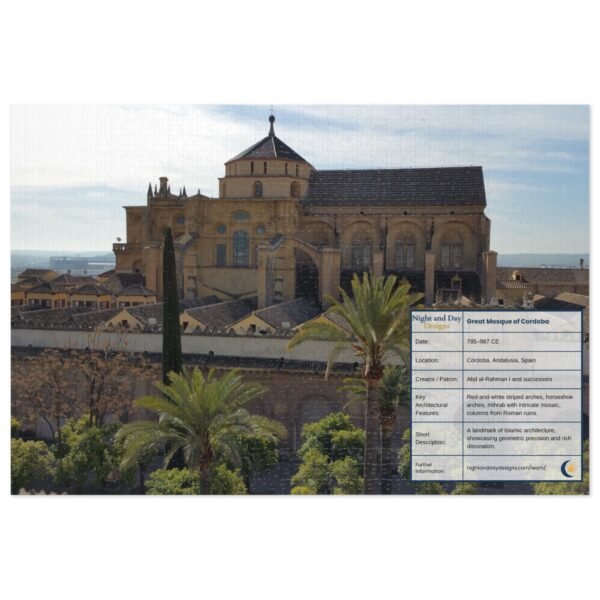
Great Mosque of Córdoba Jigsaw Puzzle – Islamic Architecture Spain Puzzle
Price range: £29.92 through £48.61